Business Card Design Guide: Sizes, Stock, Bleed & Finishes
A business card is one of the smallest things a designer will ever produce, and one of the least forgiving. There's no room for a layout to breathe, no space to hide a mistake in file setup, and any error in bleed or colour mode shows up as a hard trim line or a dull, off-brand print. This guide covers what actually needs to be right: standard Australian sizing, paper stock and weight, finish options, and the bleed and safe zone rules that separate a clean print job from a reprint.
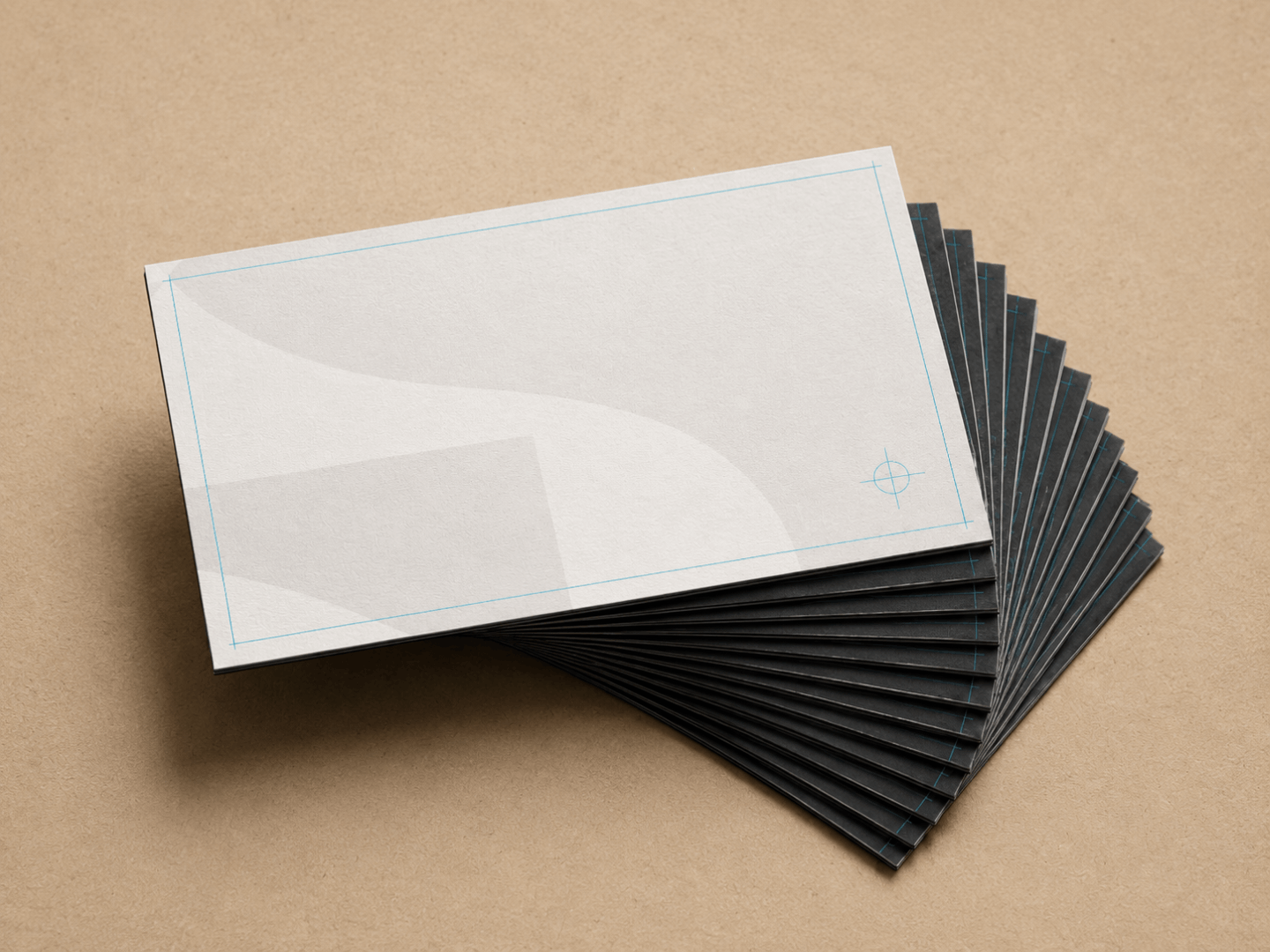
- The standard Australian business card size is 90mm x 55mm, trimmed from a file built with 2-3mm of bleed on every edge.
- Keep all text, logos, and important elements at least 3-5mm inside the trim edge, inside what's called the safe zone.
- Paper weight for business cards typically runs from 300gsm to 350gsm for a standard card, up to 400-450gsm for a premium or luxury feel.
- Finish choice (matte, gloss, soft-touch, uncoated, spot UV, foil) changes both how the card feels and what it costs to print.
- Files should be built in CMYK at 300dpi and exported as a print-ready PDF, ideally to the PDF/X-1a standard most Australian printers ask for.
Standard business card sizes in Australia
The standard business card size in Australia is 90mm x 55mm. It's close to a credit card in proportion, which is deliberate: it's the size most wallets, cardholders, and card scanners are built around. This differs slightly from the US standard of 88.9mm x 50.8mm (3.5in x 2in), so if a template or printer defaults to imperial sizing, check it against the Australian dimension before finalising a layout.
Some printers offer square cards (55mm x 55mm) or slimline cards (85mm x 55mm) as design-led variations. These can work well for a brand that wants to stand out, but they come with two practical costs: not every cardholder or wallet slot accommodates them, and non-standard sizes are usually a custom die-cut, which adds cost and turnaround time compared to a standard trim.
Bleed and safe zone, and why they matter
Bleed is the extra artwork printed beyond the trim edge, there to cover for the small amount of movement that happens when a sheet of cards is guillotine-cut. Without it, cutting tolerances of even half a millimetre can leave a thin white sliver at the edge of a card with a full-colour background. Most Australian print shops ask for 2mm of bleed on each side, though some request 3mm, so it's worth confirming before final export rather than assuming.
The safe zone works in the opposite direction: it's the margin inside the trim edge where nothing critical should sit. Text, logos, and contact details need to stay at least 3-5mm inside the trim line. Anything closer risks being cut off if the trim shifts even slightly, and text sitting right at the edge reads as a mistake even when the card technically prints fine.
A useful way to think about it: bleed protects the background, safe zone protects the content. Both exist because print trimming is mechanical, not digital, and mechanical processes have tolerances that design files need to account for.
Paper stock and weight
Paper choice affects how a card feels before anyone reads a word on it, and it's one of the areas where cheap and premium print jobs diverge most obviously.
Weight (GSM): Standard business cards typically use stock between 300gsm and 350gsm. Anything lighter starts to feel closer to a flyer than a card. Premium and luxury cards run from 400gsm up to 600gsm or higher, using either a single heavy sheet or two sheets laminated together (a duplex card), which also allows for a different colour or texture on each side.
Coated vs uncoated: Coated stock has a smoother, slightly sealed surface that handles colour and photography well. Uncoated stock has a more tactile, natural feel and tends to suit brands leaning into a craft or minimal aesthetic, though it shows fingerprints and wear more readily on solid colour blocks.
Cotton and speciality stocks: Cotton or recycled fibre stocks carry a texture and weight that reads as premium immediately, and they're often chosen specifically to signal that positioning. They cost more per unit and usually require a print run through a specialist rather than a standard online printer.
Finishes worth knowing
Finish is the layer applied over or into the stock after printing, and it's where a lot of the perceived quality of a card comes from.
Matte laminate gives a smooth, non-reflective surface that resists fingerprints and reads as understated and professional. It's the most common finish for corporate and professional services cards.
Gloss laminate is reflective and makes colour and photography pop, but it shows fingerprints and scuffs more readily than matte.
Soft-touch (velvet) laminate has a slightly rubberised, tactile surface. It's a popular premium choice because it's immediately noticeable to touch, though it's one of the pricier standard finishes and can show scratches over time.
Spot UV applies a glossy raised coating to specific elements, typically a logo or a section of the design, over a matte base. It adds contrast and a subtle tactile element without covering the whole card.
Foil stamping presses metallic foil (gold, silver, copper, and other colours) into the stock, usually for a logo or key detail. It reads as premium immediately but is one of the more expensive finishes because it requires a separate die.
Embossing and debossing raise or press elements into the stock itself rather than adding a surface layer. Often combined with foil or used on uncoated stock for a subtle, texture-led effect.
Edge painting and rounded corners are smaller finishing touches, colouring the cut edge of a thick card or rounding the corners, that add a distinct feel without the cost of a full specialty finish.
More finishes generally mean more cost and longer turnaround, since several require a separate production step or a different printer entirely. The practical approach is to pick one finish that supports the brand rather than combining several for effect.
Preparing print-ready files
Print and screen use different colour systems, and getting this wrong is the most common reason a printed card doesn't match what was designed on screen.
Design in CMYK, not RGB. Screens display colour as light (RGB); print builds colour from ink (CMYK). A design built in RGB and converted late will often shift, particularly in blues and greens, and bright or neon-adjacent colours may not be achievable in CMYK printing at all.
Work at 300dpi. Anything lower and fine detail, particularly small text or thin lines, prints soft or blurred.
Convert fonts to outlines, or embed them fully, before exporting. A font that isn't installed on the printer's system will either substitute silently or fail to render, and neither is caught until the cards arrive.
Export as a print-ready PDF. Most Australian printers ask for PDF/X-1a, a standard that flattens the file, embeds fonts, and locks in CMYK colour, removing most of the variables that cause print errors. If a printer specifies a different export standard, follow theirs; it's there for a reason specific to their production process.
DIY vs commissioning a designer
A straightforward, single-colour card with clean typography is genuinely achievable with a template tool, provided the bleed, safe zone, and colour mode rules above are followed. Where DIY starts to struggle is when the card needs to carry a full identity system consistently, matching exact brand colours, using the correct logo lockup, applying typography that's been chosen for a reason rather than a default. That consistency is part of what a broader brand identity system is meant to deliver, and a card designed in isolation from that system often looks slightly off even when nothing is technically wrong with it.
Commissioning a designer makes more sense once print finishes get involved. Spot UV, foil, and embossing all need separate build files (often a spot channel or a die line) that most template tools aren't set up to produce, and a printer will usually push a poorly prepared file back rather than guess at what was intended. If a business card is being built as part of a wider identity project rather than a standalone item, it's worth reading how a design brief actually gets built before committing to a scope, since cost and process for a supporting piece like a business card usually sit differently to a standalone logo commission.
What business card printing costs in Australia
Pricing depends more on quantity, stock, and finish than on the printer itself. As a general guide: a small run of 250 standard cards on 350gsm stock with a single matte or gloss laminate finish from an online printer typically runs $50 to $120. The same run through a local print shop, or with a premium stock and a finish like soft-touch or spot UV, usually sits between $120 and $300. Runs involving foil, embossing, or a fully custom die-cut shape can run higher again, largely because of the separate production step each of those finishes requires.
Turnaround also varies with complexity. A standard online print job usually ships in 3-7 business days. Specialty finishes or a local print shop running a custom job can take one to two weeks depending on their queue.
Frequently asked questions
- What size is a standard business card in Australia?
- The standard Australian business card size is 90mm x 55mm. It's slightly larger than the US standard of 88.9mm x 50.8mm, so check any imported template against local sizing before finalising a design.
- Do business cards need bleed?
- Yes, if any part of the design (a background colour, image, or graphic element) runs to the edge of the card. Most Australian printers ask for 2-3mm of bleed on each side to allow for cutting tolerances.
- What paper weight should I use for a business card?
- Standard cards typically use 300gsm to 350gsm stock. Premium or luxury cards run from 400gsm up to 600gsm or higher, sometimes as two laminated sheets for a duplex finish.
- Can I design and print business cards myself?
- Yes, for a straightforward layout on a standard finish, provided bleed, safe zone, and CMYK colour mode are set up correctly. Complex finishes like spot UV, foil, or embossing generally need a print-ready file built by someone familiar with those production requirements.
- How much do business cards cost to print in Australia?
- A small run of standard cards typically costs $50 to $120 through an online printer, or $120 to $300 for premium stock, specialty finishes, or a local print shop. Foil, embossing, and custom die-cuts push the price higher due to the extra production step involved.
If you're setting up files for the first time, our roundup of useful design tools covers a few options worth having on hand for mockups and file checks before a job goes to print.